Surely you have heard the term “close the loop”. It is a phrase in English that, translated, would be “close the circle”. When we talk about customer experience, it translates as the ability of companies to collect the feedback offered by customers and act accordingly in a proactive and systematic way, thus improving their perception of us. It is the process by which companies bridge the gap between customer expectations and the actual experience they receive.
Customer feedback is a very valuable factor and without which Close the Loop is not possible. By actively listening to the customer, the customer provides us with valuable information, with which we can manage our decision-making and which allows us to know in detail the needs, expectations and concerns of our customers. By listening to what customers have to say, we can identify areas for improvement and take corrective action before problems expand and become entrenched. In addition, customer feedback also provides information on what does work, allowing us to reinforce and replicate the positive aspects of the customer experience.

How can we apply Close the Loop?
Based on the feedback we receive and unmet customer expectations, we must act to ensure continuous and tangible improvement, which translates into greater customer satisfaction. There are several strategies we can apply to correctly implement Close the Loop.
Feedback Monitoring
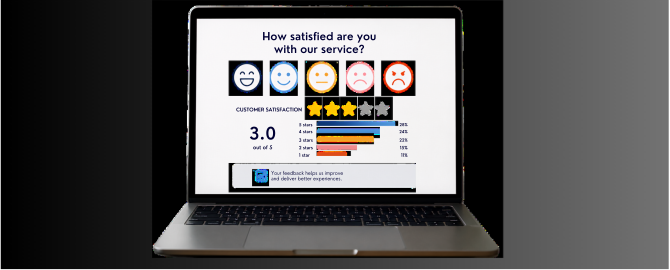
We can implement monitoring systems that allow us to know customer opinions in real-time and collect any problems that may arise. It is important to note that the company should actively seek customer feedback and not wait for customers to decide to respond, as we might overlook minor issues that customers do not consider important enough to report through the company’s channels. Therefore, these monitoring systems must be active and accessible. Surveys are a very useful tool for this purpose.
Customer Response
Every customer who reports a problem does so in a different way and for a different reason. That is why each customer expects their problem to be treated with the same relevance and uniqueness it presents. We must avoid automated and empty responses that leave customers feeling that no action is being taken. A personalized response focused on their problem will provide them with security and satisfaction, making them feel that the company takes their issue seriously and is working to resolve it and improve. The commitment we show as a company will translate into customer loyalty.
Trends and Patterns
By periodically analyzing all problem responses we receive, we can identify complaint trends and patterns that indicate priority areas for improvement, offering us an operational advantage to know where to prioritize enhancements to satisfy the largest number of customers.
Communicating Our Feedback
For the customer, knowing that their complaint has been addressed and has led to some change is a great satisfaction. That is why, when we make changes, however small, based on problems detected through customer feedback collection, it will be important to communicate them so that customers can feel that satisfaction and improve their opinion of us by witnessing firsthand the commitment we show and our willingness to improve the service.
So now you know, in an increasingly competitive and customer-centric market, Close the Loop can be your best ally for fostering customer loyalty and improving your results, as well as providing insight into the most urgent areas for improvement.
At Opinat, we are experts in techniques like Close the Loop. Our customer loyalty measurement software features tools that make this entire process possible and ensure that the customer feels heard throughout. Do not hesitate to contact us if you want to learn more about the capabilities our software can offer you and the advantages of Close the Loop.