The Net Promoter Score (NPS®) is one of the world’s most widely used Customer Experience (CX) metrics for measuring customer loyalty. Its success stems from a very simple reason: a single question reveals the likelihood that a customer will recommend a company, product, or service.
Although its premise is simple, the true value of NPS® lies not only in the score obtained, but in the ability to understand why customers respond as they do and to act accordingly.
The NPS® Question
The NPS® methodology is always based on the same question:
“To what extent would you recommend our product or service to a family member, friend, or colleague?”
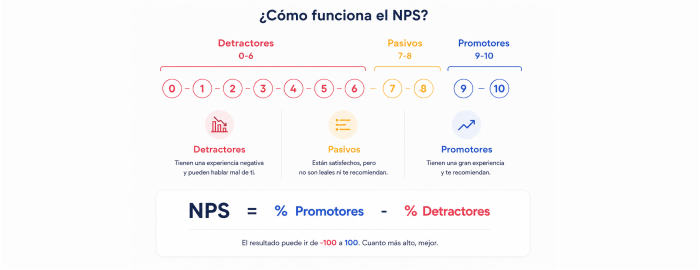
The customer responds using a scale from 0 to 10, and based on their response they are classified into one of these three groups.
Promoters (9-10)
They are the most satisfied and loyal customers. They buy more frequently, recommend the brand spontaneously, and tend to generate greater long-term value.
The goal with them is to maintain that satisfaction, strengthen the relationship, and turn them into true brand ambassadors.
Passives (7-8)
They are satisfied customers, but without an emotional connection to the company. They don’t usually speak negatively about the brand, although they don’t actively recommend it either, and they can easily switch to the competition if they find a better alternative.
Identifying them is fundamental to understanding what they lack and what improvements can turn them into promoters.
Detractors (0-6)
They have had a negative experience or one that fell short of their expectations. In addition to abandoning the brand, they may share unfavorable opinions that affect the company’s reputation.
In these cases, it’s not just about knowing the score, but understanding the reason and acting quickly. A Close the Loop process allows you to contact the customer, resolve the issue, and prevent a temporary problem from becoming a permanent loss.
How is NPS® calculated?
The calculation is very simple:
NPS® = % of Promoters − % of Detractors
Passive customers are not involved in the calculation, although their feedback remains very valuable for identifying opportunities for improvement.
The result is always expressed with a value between -100 and +100.
What is considered a good NPS®?
There is no single value that applies to all sectors. Each industry has different benchmarks, so it’s always advisable to compare yourself with companies in the same market.
As a general guideline:
- Below 0: there are more detractors than promoters. This is a warning sign that requires identifying the causes of dissatisfaction and addressing them.
- Above 0: there are more promoters than detractors, indicating a mostly favorable customer base, but with plenty of room for improvement.
- Above +30: is generally considered a good result in most sectors.
- Above +50: reflects a very high level of satisfaction and loyalty.
- Above +70: corresponds to organizations that offer clearly differentiated and hard-to-find customer experiences.
Rather than chasing a specific number, what is really important is to constantly evolve the indicator.
The true value lies in knowing the reason.
A rating alone tells you very little. What’s truly useful is also asking why the customer gave that rating.
The responses allow us to identify the aspects that most influence the customer experience and transform that information into actionable knowledge. In fact, by analyzing the motivations of each group, it’s possible to construct a SWOT analysis of the customer experience:
- The promoters highlight the company’s strengths.
- Passives help identify opportunities for improvement that can increase customer loyalty.
- Detractors reveal weaknesses and, in many cases, also threats that can affect reputation or lead to the loss of customers.
This analysis facilitates the prioritization of improvement actions and allows for decisions to be made based on the voice of the customer, not on assumptions.

Benefits of using NPS® in a Customer Experience strategy
The NPS® has become an international standard because it combines simplicity with great analytical capabilities.
Among its main advantages are:
- It is easy to implement. A single question allows you to obtain valuable information with minimal effort from the customer.
- It facilitates comparisons. It can be used to compare products, services, stores, channels, or even the evolution of the company over time.
- Prioritize action. It allows you to quickly identify which customers need immediate attention and which ones can become brand advocates.
- It drives continuous improvement. Periodic measurement helps to assess the impact of changes made and detect new opportunities for improvement.
The NPS® starts generating value after the survey
Gathering feedback is just the first step. What truly improves the customer experience is transforming that feedback into concrete actions.
That’s why more mature organizations combine NPS® with Close the Loop processes, which allow them to automatically contact dissatisfied customers, resolve issues before they escalate, and measure whether the actions taken have actually improved their perception.
At Opinat, we help companies turn every response into an opportunity for improvement. Our platform automates alerts, facilitates the tracking of critical cases, and provides reports that enable data-driven decision-making.
Because measuring satisfaction is important. But acting on it is what truly makes the difference.