
There are companies that know their products, their processes and their numbers well, but today they do not know for sure if their customers are happy or not, and not because they do not care, but because they have never had a system to know it reliably.
And yet, understanding that perception is critical. Customers don’t make decisions based solely on the features of a product or the efficiency of internal processes. They do so based on the expectations they had and the experience they ultimately live.
That’s why measuring customer satisfaction isn’t just about asking if someone was happy, it’s about getting insights that allow you to identify what’s working, what’s causing friction, and what needs to be improved.
What is customer satisfaction?
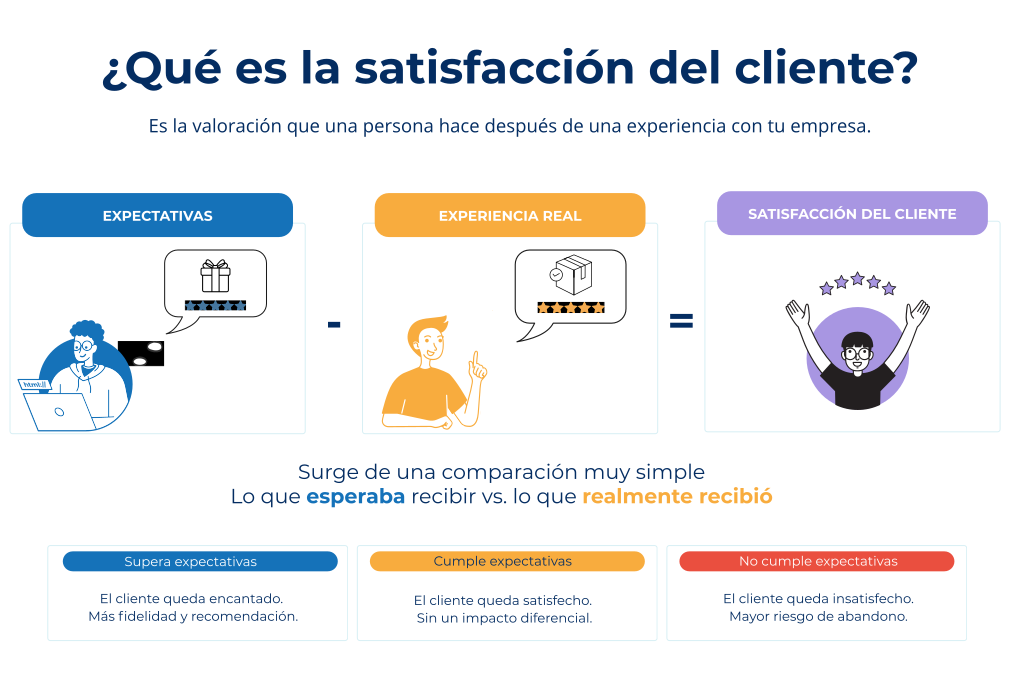
Customer satisfaction is the assessment that a person makes after an experience with a company, a product or a service.
This assessment arises from a very simple comparison: between what you expected to receive and what you have actually received.
When the experience meets their expectations, the customer is usually satisfied. When they exceed them, the likelihood that they will buy again or recommend the brand increases, but when the experience is below expectations, dissatisfaction appears.
Therefore, the important thing is to understand that satisfaction does not depend only on the product, but is also conditioned by factors such as the attention received, the ease of processes, communication, waiting times or the resolution of incidents.
That’s why two companies offering similar products can generate completely different levels of satisfaction.
Why is it important to measure satisfaction?
Many organizations still use proxy indicators to interpret how their customers feel: they look at the number of complaints, sales, or churn rate and try to draw conclusions from them. However, there’s a problem, and that’s that data shows consequences, not causes.
Measuring satisfaction directly allows us to detect these signals before they escalate, but above all it provides something that operational indicators do not offer: context. Not only if the experience has been good or bad, but also what specific aspects are influencing that perception and at what point in the journey it is happening.
How Customer Satisfaction Is Measured
Measuring customer satisfaction requires two elements: metrics that indicate what is happening and tools that allow you to collect, analyze and convert that information into improvement actions.
Metrics help evaluate different aspects of the experience. NPS® measures loyalty and likelihood of recommendation; CSAT, satisfaction after a specific interaction; CES, the effort it took for the customer to complete a transaction; and NEV, the emotional impact generated by the experience.
But measuring is not just about choosing an indicator. It is also necessary to have a platform that allows you to launch surveys at the right time in the customer journey, centralize responses, segment results, detect patterns, and facilitate the monitoring of improvement actions.
The combination of metrics and tools is what offers a complete view of the customer experience and allows you to turn feedback into decisions that improve satisfaction.
How to Improve Customer Satisfaction
Improving satisfaction doesn’t start with launching a survey, it starts with being clear about what you’re going to do with the data before collecting it.
The most effective process always follows the same logic: measure in the moments that matter, analyze what is going wrong and where, act on those specific points and close the loop with the customer when possible. That last step — informing them that something has changed thanks to their opinion — is the one that has the most impact on loyalty and the one that companies do the least.
Closing the loop not only helps strengthen the relationship with the customer, but that follow-up contact is also what makes it possible to distinguish whether a bad experience is an isolated case or a systemic problem.
An unhappy customer may be an exception. Several customers dissatisfied for the same reason are a signal that requires a structural, not individual, response.
Most common mistakes when measuring customer satisfaction
Many companies collect feedback from their customers, but they don’t always get useful information to improve the experience. Here are some of the most common mistakes:
- Measuring only once a year and losing sight of what happens between one measurement and another.
- Use a single metric for the entire customer journey, without taking into account that each stage requires a different indicator.
- Analyze only the numerical results and leave aside open comments, where the causes of problems are usually found.
- Do not close the loop with the customer after receiving their feedback.
- Collect information without turning it into concrete improvement actions.
Avoiding these errors allows measurement to stop being a follow-up exercise and become a useful tool for making decisions.
How Opinat helps you improve customer satisfaction
Designing a customer satisfaction program requires more than a tool to send surveys. It requires a system capable of collecting feedback at the right times, analyzing it automatically, and turning it into concrete actions.
With Opinat Customer Experience , teams can trigger CX surveys throughout the entire customer journey, analyze feedback in real-time, receive alerts to critical situations, and access reports designed to make decisions.
In this way, customer satisfaction ceases to be an intuition and becomes an indicator that the company can manage, improve and demonstrate.
If you want to know more about related topics, we invite you to read this other article: What is CX and why does it define the future of any company?