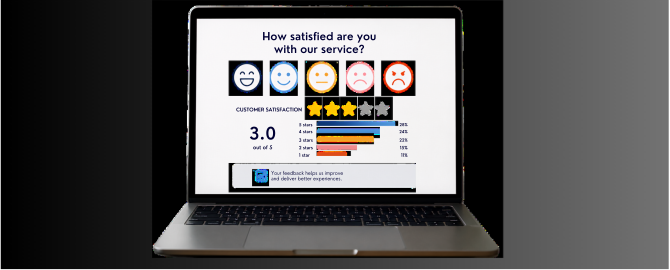
Digital surveys have become one of the most widely used tools to find out the opinion of customers, patients or employees. However, when it comes to creating them, doubts arise about how to do them well.
What is a digital survey?
The digital survey is a questionnaire that is carried out through digital means to collect the opinion of a person at a specific time.
You can create, configure, and customize them through a survey software platform and send them through different channels: email, SMS, mobile apps, QR codes, websites, and more.
This type of survey allows you to customize the questionnaire flow, create visually striking and fully automated questionnaires for your audience and, above all, obtain real-time insights.
The choice of platform is a determining factor, although needs vary depending on the maturity of the business: while a small business may start with a free solution, others will require a higher level of customization and ongoing support. However, technology is not a substitute for strategic judgment: the real value lies in asking the right questions, at the right time, and through the right channel.
When to send the digital survey
The success of a survey does not depend solely on the questions it contains. The timing of when feedback is requested can be equal to or even greater than the quality of the responses obtained.
Therefore, an honest answer is: it depends on the service and the context.
It’s true that sending a survey right after an interaction usually generates more accurate responses, because the details of the experience are still fresh, but that doesn’t mean that always sending in real-time is the right strategy.
In an emergency department, a client who has just experienced a situation of stress or long waiting time may be too upset to give a thoughtful response. An immediate message at that moment can be invasive and generate more noise than useful information. If time is allowed to pass, that same person can offer a more complete assessment, with more context and more actionable data.
The timing strategy is not universal, you have to consider the type of service, the level of sensitivity of the moment, the channel chosen and the objective of the measurement. The most effective listening programs do not always send in real time: they define the time of sending as part of the project design, not as a last-minute technical adjustment.
Key Advantages of Online Surveys
Digital surveys offer benefits that go far beyond automating the data collection process. Well integrated into a Customer Experience strategy, they allow you to better understand your customers and react more quickly to their needs.
Alerts and immediate reaction
Some platforms allow you to trigger an alert as soon as you receive a negative response, which helps detect friction points before they affect loyalty. Not all tools offer this feature, so it’s worth checking if it’s a priority for your business.
Increased touchpoint coverage
Digital surveys can be activated at different times of the customer journey, offering a much more complete view of the experience that each customer lives throughout their relationship with the organization.
Quantitative and qualitative information
The combination of indicators such as NPS,® CSAT in combination with the NEV allows us to know not only the level of satisfaction, but also the reasons that explain each assessment.
Large-scale analysis capability
As responses increase, manual analysis is no longer viable. Specialized platforms allow you to classify comments, identify trends, and detect patterns that facilitate decision-making.
Greater capacity for action
When feedback is integrated into monitoring and alerting processes, surveys are no longer a measurement exercise but a management tool that helps to improve the customer experience continuously.
What Survey Software Needs to Offer You to Be Truly Effective
Beyond the wording of the questions, the technological tool you choose will determine the success or failure of your listening strategy. Not all platforms on the market offer the same features, so when evaluating solutions, it is important to make sure that they cover four fundamental pillars:
- Omnichannel architecture and intelligent flows: The software should adapt to your customer’s preferred channel (email, SMS, WhatsApp, web) and allow conditional logic. If the platform integrates with your CRM or ERP, you will be able to link internal variables – such as purchase history or the agent who attended – without the need to request them from the user. This reduces customer fatigue and increases response rates.
- Flexible measurement models according to the objective: Make sure that the tool allows you to deploy different types of questionnaires depending on the moment of the customer journey. You can take these work methodologies as a reference:
- An NPS survey template to assess global brand loyalty.
- A CSAT survey template to measure satisfaction after a one-off interaction.
- A CES survey templey to analyze ease and effort in incident resolution.
- Alert automation and Closed the Loop: A measurement is useless if it does not generate action. The technology should allow automatic alerts to be set up for any assessment, so that the service team intervenes according to the situation. Similarly, in the event of positive feedback, the system should be able to redirect the user to public platforms such as Google Reviews to boost the company’s digital reputation.
- Artificial Intelligence Word Processing: When managing large volumes of responses, manual reading is no longer viable. It is imperative to have an AI and natural language processing engine that classifies open comments, detects user sentiment, and groups top topics into automatic executive reports.
👉 Request a demo and start listening to what your surveys aren’t telling you yet.