
Not all the interactions that a customer has with a company generate the same memory; some go unnoticed; others leave a footprint, good or bad, that influences what that customer will do next: if they return, if they recommend or if they cancel silently without giving explanations. The NEV exists precisely to measure that emotional footprint that other metrics are not able to capture.
What is Net Emotional Value (NEV)?
The Net Emotional Value, or NEV, is A customer experience metric that measures the net emotional impact of every interaction with a brand, product, or service.
The concept was developed by Colin Shaw, founder of Beyond Philosophy, in collaboration with the London Business School and published in his book The DNA of Customer Experience (Palgrave Macmillan, 2007). It is not a new metric, but it is one of the least implemented, in part because it requires a step that many companies have not yet taken: measuring emotions in a systematic way, not just satisfaction.
What differentiates NEV from metrics like NPS® or CSAT?
CSAT asks if the customer was satisfied. NPS® asks if they would recommend the company. Both generate a number: the customer scores, and that score becomes an indicator.
But the NEV works in a different way. It is not obtained from a question with a numerical scale, but from the analysis of the open comments that customers leave in the surveys. This is where the real emotions appear: frustration, surprise, confidence, among others. That is why the NEV is not a piece of data that the customer gives you directly; it is a value that is extracted and interpreted from what they say in their own words.
This makes it richer and more complex at the same time: it does not appear in all the surveys answered, and its analysis at scale was, until recently, practically unfeasible without technology. Artificial intelligence changes that equation: by analyzing thousands of comments with the same criteria and without interpretation biases, the NEV becomes measurable at real scale. That is one of the reasons why this metric is currently gaining relevance.
How is Net Emotional Value (NEV) calculated?
The formula is straightforward:
NEV = Average Positive Emotions − Average Negative Emotions
The result, positive or negative, reflects the emotional balance that the company generates at each point of contact. A positive NEV indicates that the prevailing emotions are favorable; therefore, a negative NEV indicates the opposite.
How do you get those emotions?
Directly from the free text that the customer writes in the survey. Today’s CX platforms with natural language analysis allow you to automatically classify that sentiment, group emotions by touchpoint, and detect when something is starting to go wrong before the customer says it explicitly, or before they simply stop responding.
Not all emotions weigh equally
One of the most relevant findings of the Beyond Philosophy research is that emotions do not generate the same business value, and they identified three levels with different effects on loyalty and growth:
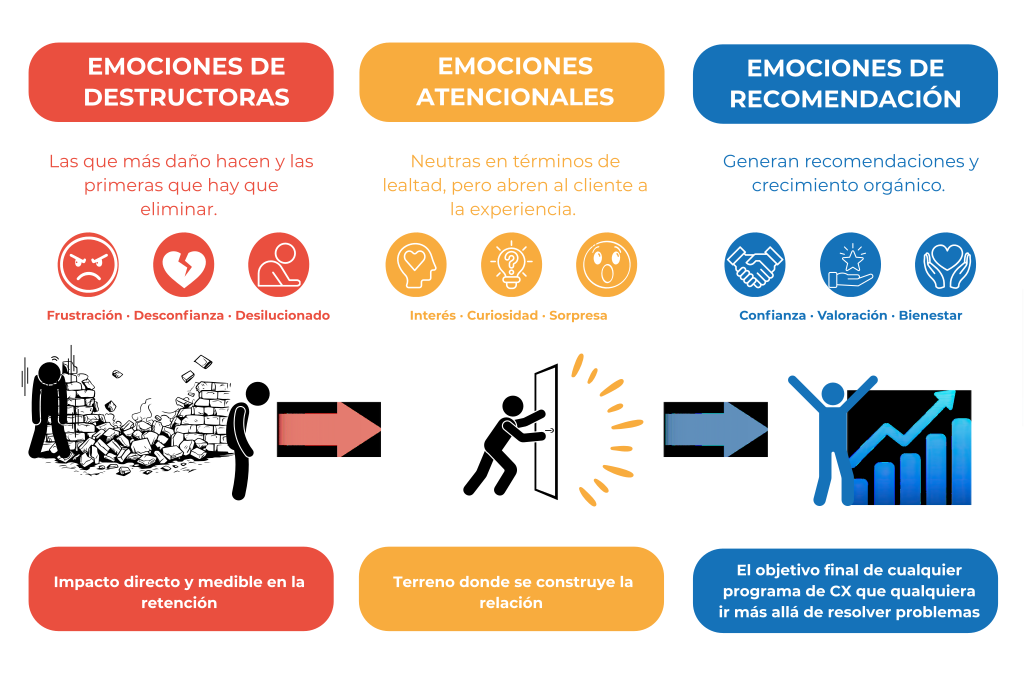
The Net Emotional Value varies by touchpoint
A customer may feel very well treated during onboarding and deeply frustrated at their first support incident. That variation isn’t always reflected in an overall satisfaction score.
When analyzed by touchpoint, the NEV provides an additional layer of understanding about how the emotional experience evolves throughout the customer journey. Combined with other experience metrics, it helps identify moments that generate positive or negative emotions and better understand their impact on overall perception.
In this way, organizations can more easily detect where relevant emotional changes occur and complement the analysis obtained through metrics such as NPS,® CSAT or CES.
Is it directly related to other numerical metrics?
Yes, but in a particular direction: a positive NEV tends to improve NPS, CSAT,® and any other numerical metric of experience. The relationship doesn’t work the other way around.
We can have an NPS® of 9 and still find in the comments the typical phrase of “All good, but…” That “but” is exactly what the NEV captures that the number doesn’t reflect. The NEV doesn’t just explain the NPS:® it explains why the customer scores as they score on any quantitative metric.
For CX teams with stagnant metrics that have solved the most obvious but are failing to make progress, the NEV often reveals exactly what the other metrics weren’t capturing.
What question should I ask myself before I start measuring it?
Before thinking about technology or methodology, there’s a more useful question: what do you want your customer to feel when they finish each interaction with your company? Being clear about this is what makes the difference between measuring emotions for the sake of measuring and using them to design something better.
With Opinat Customer Experience you can measure the NEV along with the rest of the metrics throughout the entire customer journey, understand what each touchpoint is generating in emotional terms and act before a bad experience becomes a cancellation that no one anticipated.
👉 Request a demo and start listening to what your metrics aren’t telling you.